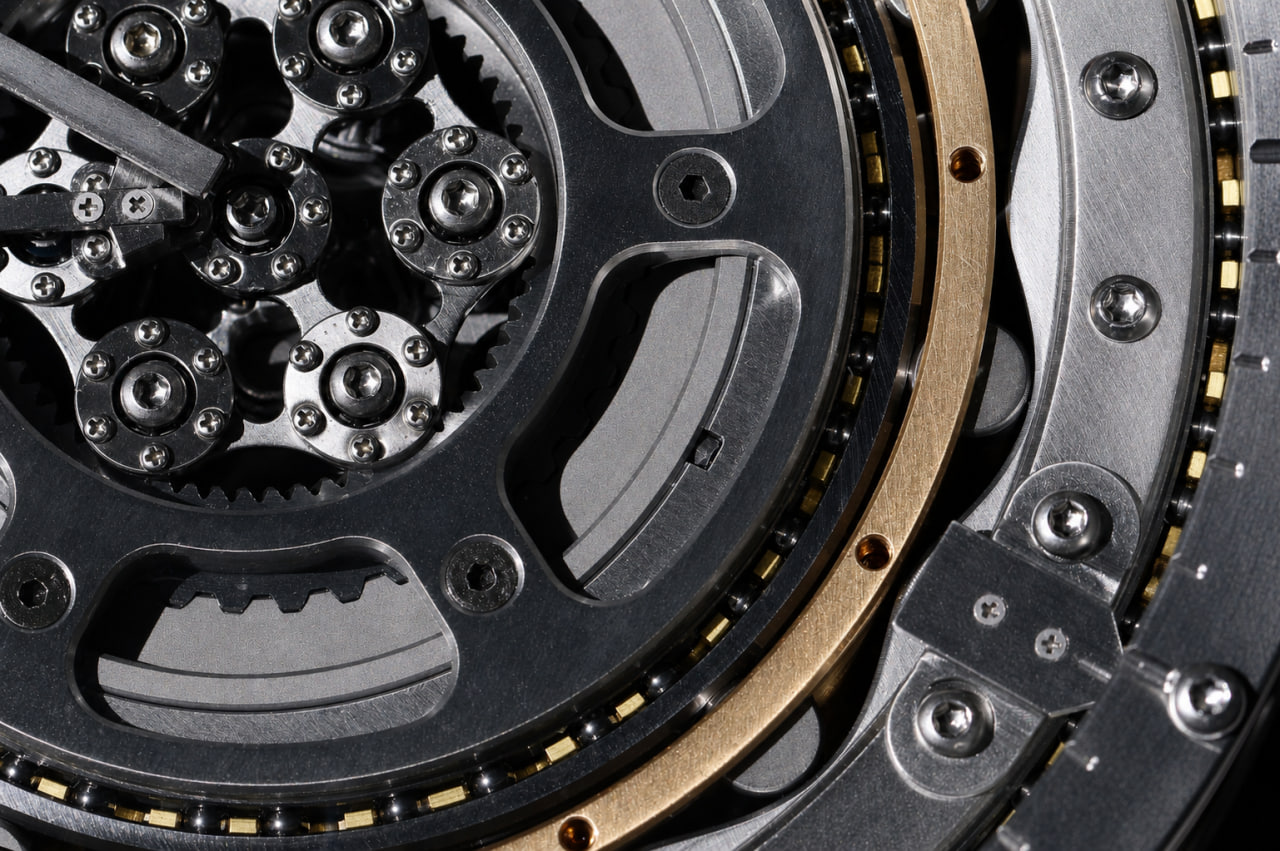
The movement, up close
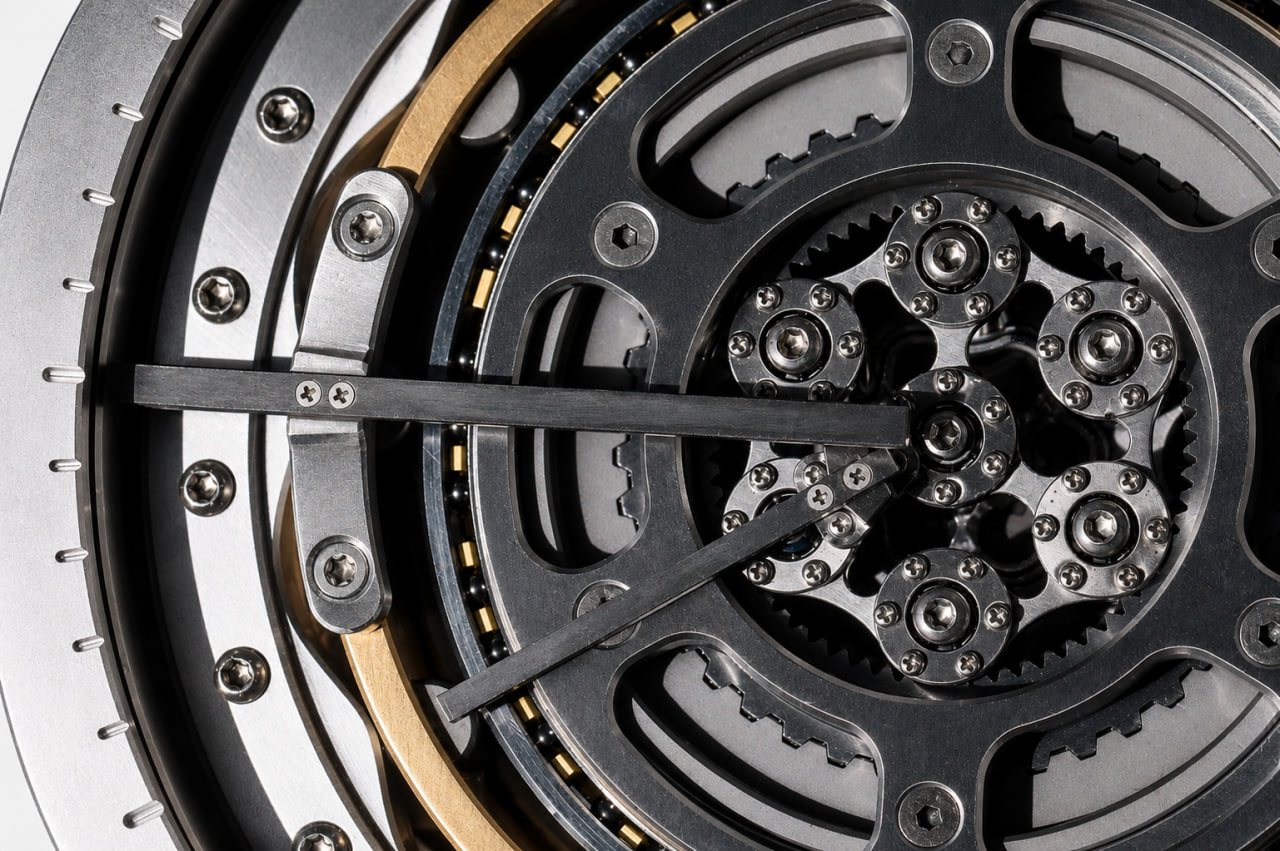
A macro view of one part of the mechanism, machined and finished.
A kinetic sculpture that keeps time in the open. The most advanced gear concepts of the mechanical industry, machined in stainless steel and brass, turning where you can watch them. Hang it on a wall, or suspend it on cables anywhere in a room.
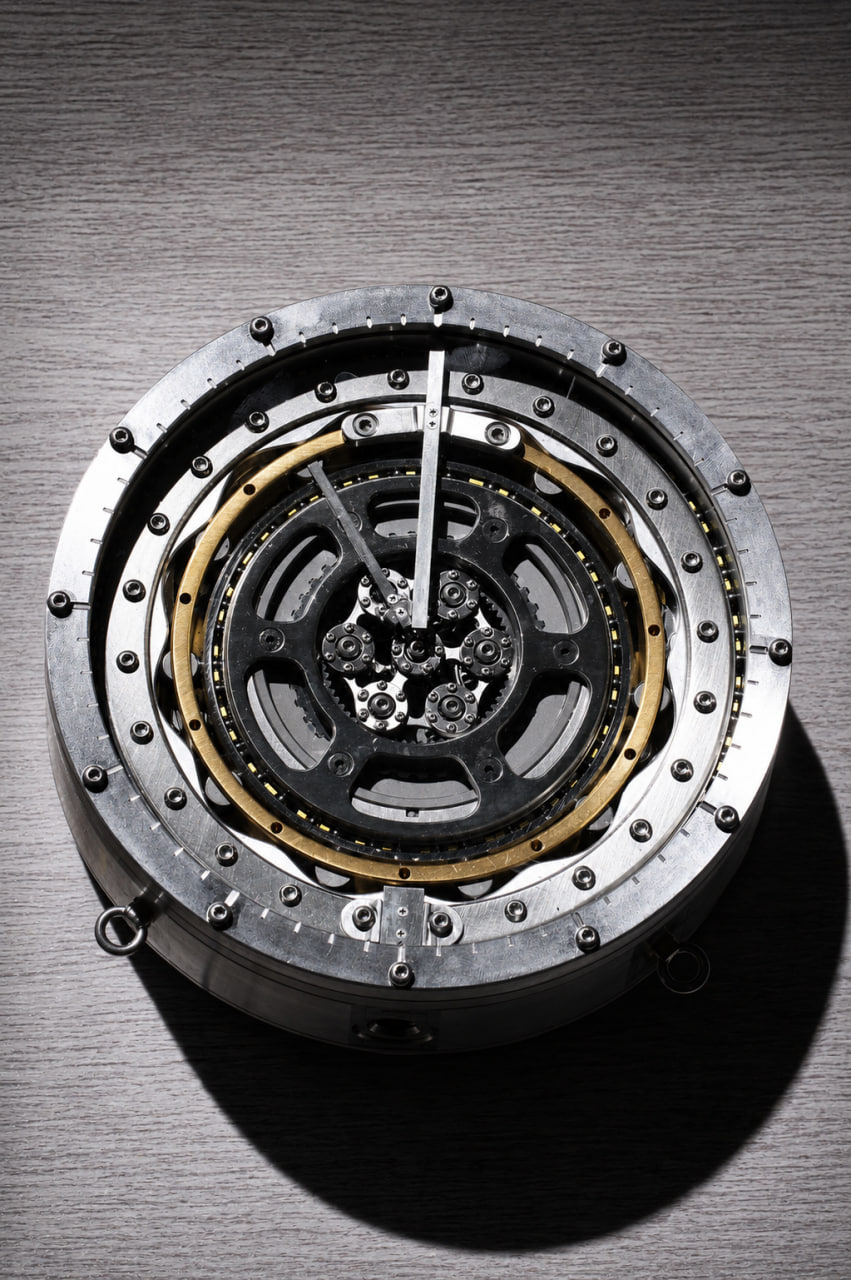
The most sophisticated gear concepts of our time steer surgical robots, aim telescopes and hold satellites on station. Nearly all of them are sealed inside metal, their elegance reduced to a line on a datasheet. This piece does the opposite. Every stage of the drivetrain is left open, every roller and planet visible as it works. The engineering is the ornament. And because the body is machined from stainless steel, this is not only a clock, nor only an object to admire. It is an artifact, made to be passed down.
Only the hands are familiar. Behind them sits an exposed drivetrain built around a rolling-element wave gearbox and a differential scheme, machined from steel and brass. A few of its parts, photographed as they came off the machine.
A macro view of one part of the mechanism, machined and finished.
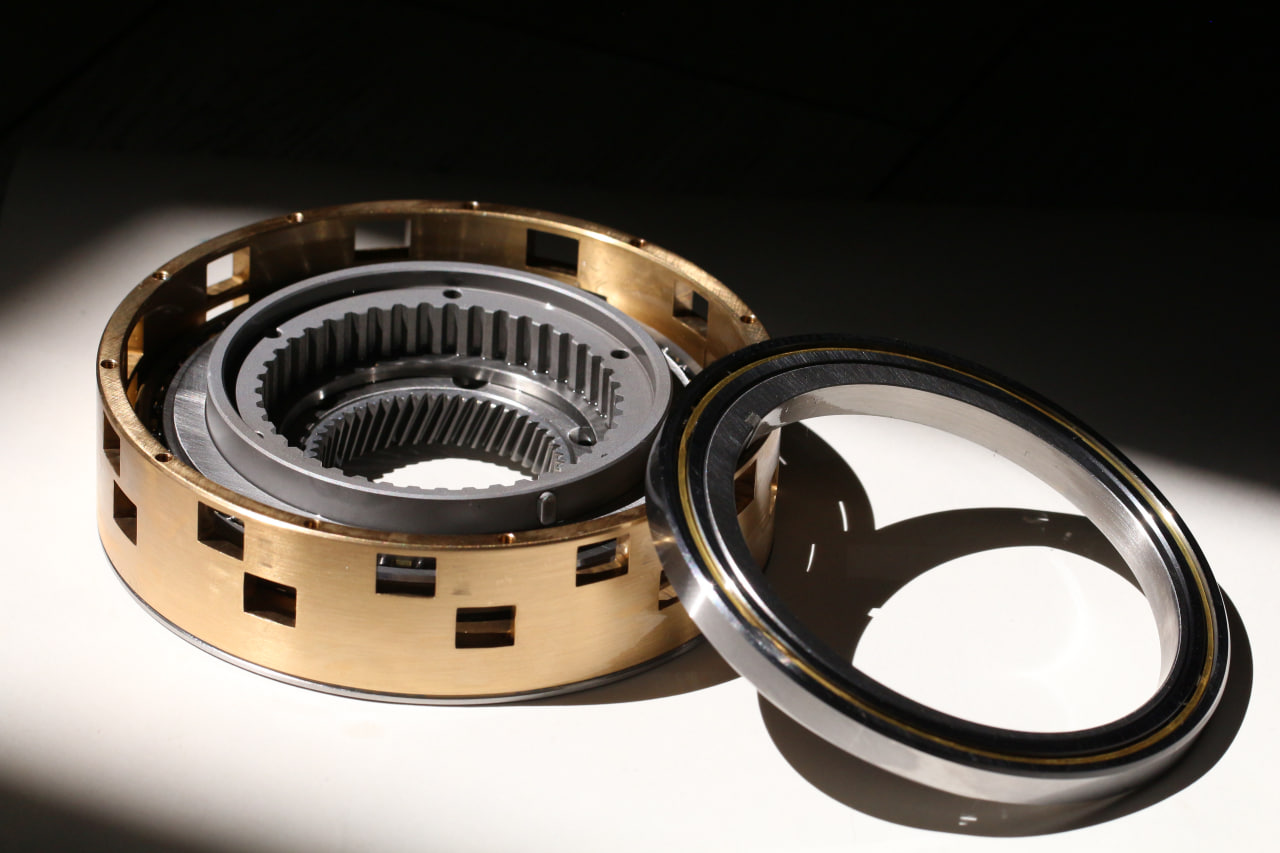
Core components of the rolling-element wave gearbox: the roller cage and the wave generator for the differential scheme.
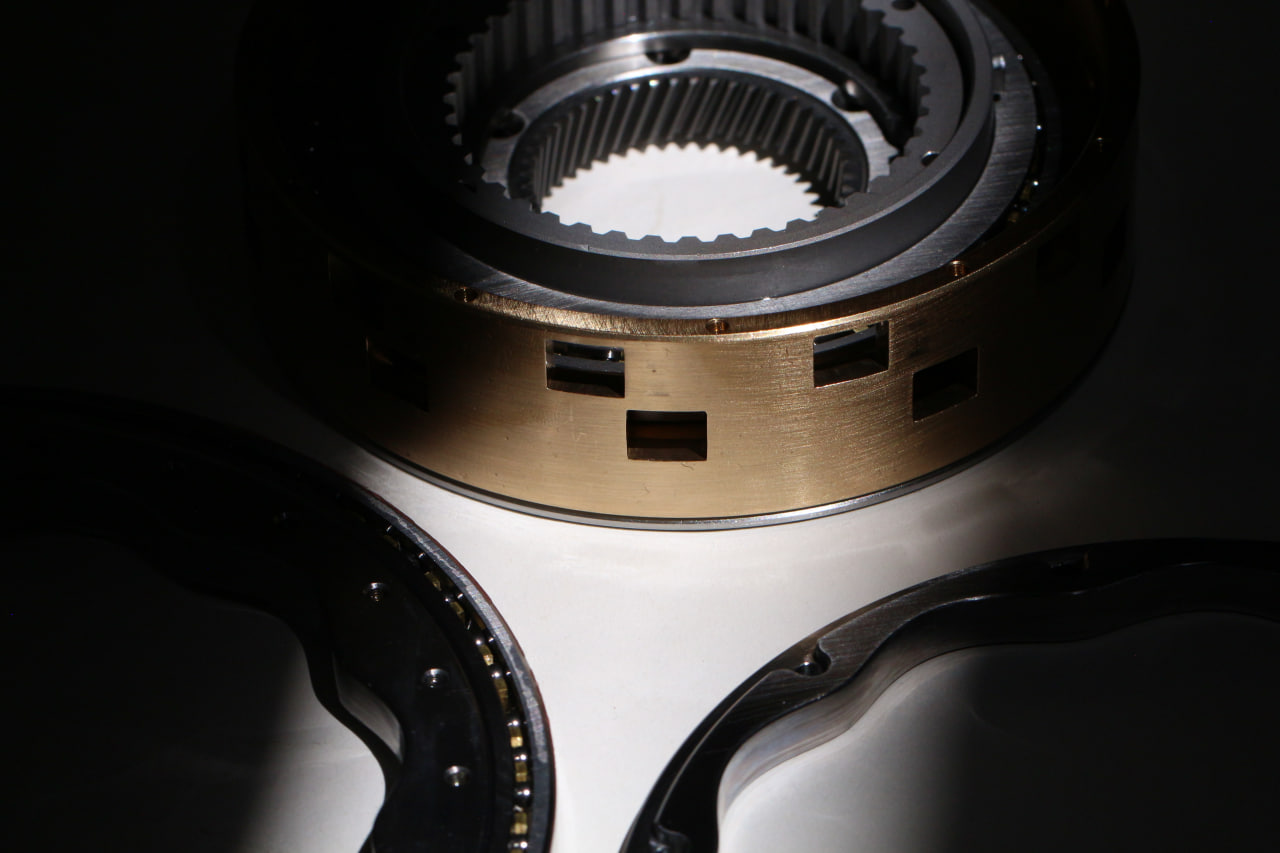
The principal parts of the rolling-element wave gearbox: the separator and the two rigid wheels.
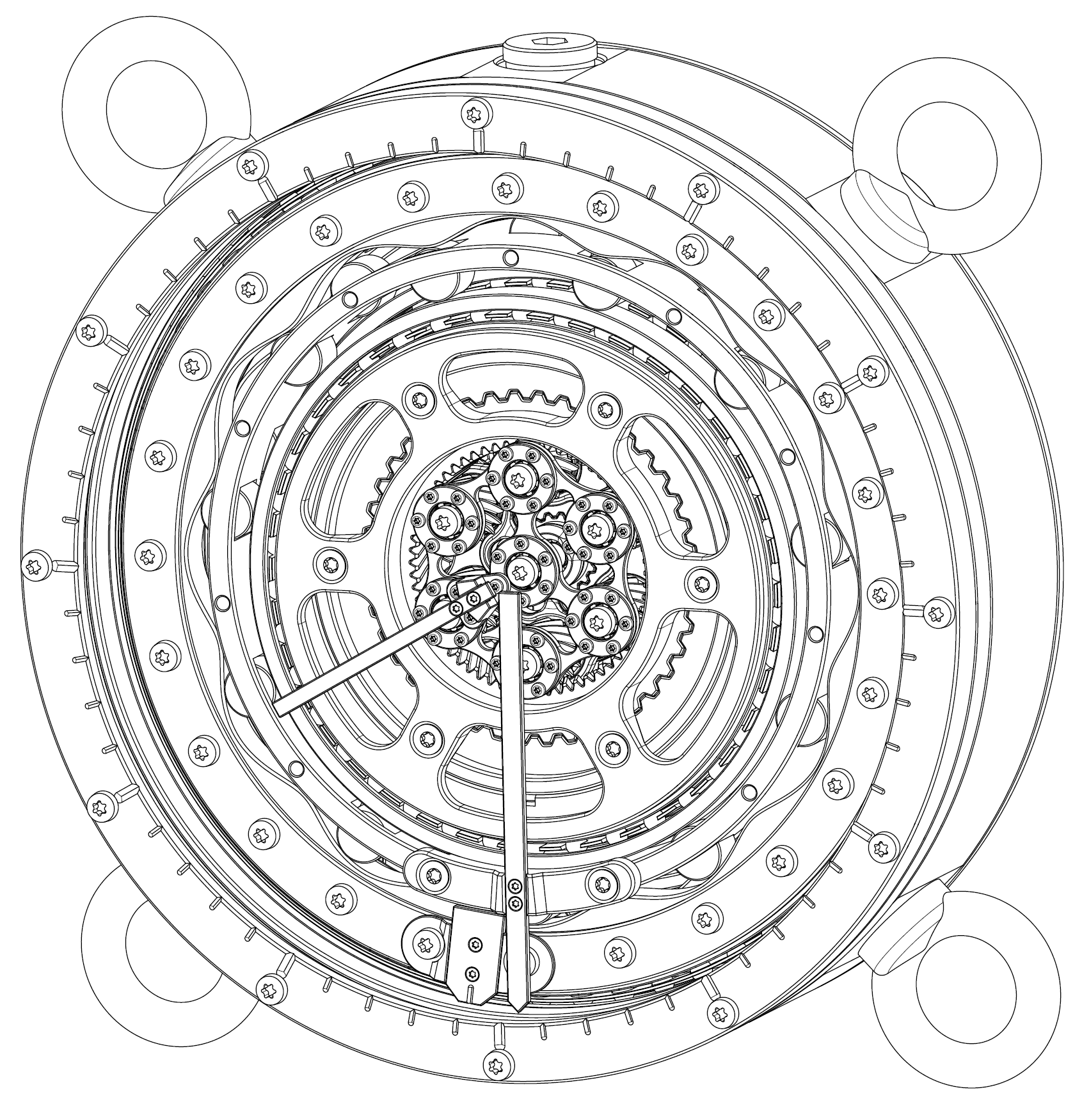
A black-and-white outline view of the assembled device.
Beneath the sculpture runs an instrument-grade control platform. It computes the true position of each shaft and holds the hands to it, correcting continuously. The hands never jump. They are quietly, permanently correct.
A brushless motor with cogging compensation, torque limiting and stall detection. Inaudible at arm's length, perfectly smooth at the pace of the second hand.
An on-board precision crystal keeps time on its own. Given a network, the clock disciplines itself against internet time. Far from any network, on open water for instance, it takes its reference from satellites.
The clock knows where it is. A new time zone, or a daylight-saving change in the small hours, is detected and absorbed on its own. You never set it.
Drift is estimated continuously and trimmed away with gentle changes in speed. Synchronisation happens below the threshold of perception.
110 or 220 VAC, USB-C Power Delivery, external DC, marine DC. It takes them all and recovers on its own after an outage.
Each clock hosts its own web interface: live status, time-source settings, synchronisation quality, diagnostics and updates, reachable from any device in your home.
Optional Home Assistant integration over your local network, so the clock reports its state and takes commands as a first-class device in your smart home. MQTT and Matter are on the roadmap.
For those who will answer to no outside reference, the clock can carry a genuine atomic clock on board. No signal, no network, nothing to depend on but physics. Offered as a paid upgrade to any commission.
Over your network the clock serves the interface below: the same status, timekeeping, movement, satellite and power telemetry the maker sees on the bench. Here it runs on simulated data so you can explore it.
51 individual parts, cut from stainless steel and brass. Photographed exactly as they left the CNC. Nothing on this page is a render except the drawings themselves.
| Form | Kinetic clock for a wall or a cable suspension, with the drivetrain fully exposed |
|---|---|
| Size | The standard format is sized for a living room. Each commission can scale in either direction, from an intimate study piece to an architectural format for a lobby or an atrium. |
| Materials | Housing machined from stainless steel; wave rings and accents in brass. An artifact made to last generations. |
| Movement | Four-stage compound gear train: planetary reducer, compound planetary differential, rolling-element wave gearbox, coupled dual-wave pair |
| Parts | 51 individually designed and CNC-machined components |
| Drive | Direct brushless drive, cogging-compensated, inaudible in a quiet room |
| Timekeeping | On-board precision crystal, disciplined by internet time when networked or by satellites when not. Time zones and daylight saving handled automatically. Optional on-board atomic reference. |
| Accuracy | Continuously held to true time; corrections stay below the threshold of visible motion |
| Connectivity | Built-in web dashboard, wireless networking, over-the-air updates, exportable diagnostics |
| Power | 110 / 220 VAC, USB-C Power Delivery, external DC, marine DC, automatic recovery after an outage |
| Editions | Standard, or the Atomic Edition with a genuine atomic clock on board |
| Provenance | Designed, machined, assembled and tuned as an author's project by one engineer. Each piece is serial-numbered and signed. |
Every clock is made to order, for one wall and one owner. The base architecture is proven; the size, materials, finishes, hands and time-source configuration are decided with you. From first agreement to first motion is about six months, and sometimes longer. A piece like this cannot be hurried, and I would rather set the expectation honestly than promise a date I would have to break.
A direct conversation with the engineer, no sales layer in between. We settle the format and size, materials, finishes and any personal touches, from engraving to an atomic reference.
Your configuration becomes a concept, a fixed price and a delivery plan. Nothing is cut until both of us are happy with it.
The configuration is carried through the full CAD model and drawing set. Custom parts go to machining; standard components are ordered from suppliers around the world, and international transit takes as long as it takes.
Hand assembly, motor calibration, cogging mapping and a functional test that runs on the workshop wall for weeks, not days.
Insured white-glove shipping anywhere in the world, guidance for wall or cable mounting, and remote commissioning on your network.
Direct support from the person who designed every part. Remote diagnostics through the on-board dashboard, over-the-air updates for life, and priority service should the piece ever need the hands that built it.
Viktor Smorygo has spent more than fourteen years bringing useful things into the physical world, mechanisms people rely on without ever seeing them. The Kinetic Clock is the exception. This time, the mechanism is meant to be seen.
Serial-numbered editions from $20,000. Bespoke configurations by conversation. Worldwide insured delivery and lifetime support from the maker. Every enquiry is answered by the engineer himself.
A small mechanical challenge guards the contacts from robots. Humans with good hands only.